
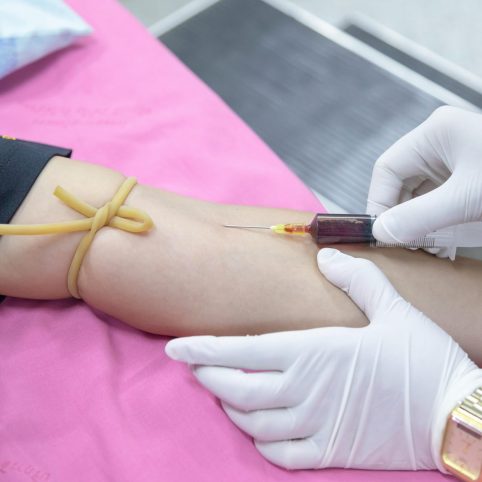
Nobody likes getting injections and a fear of needles and painful procedures in children is normal. Fear is a normal response to a threat (in this case, needle insertion) that involves three response systems, physiological arousal, covert feelings and thoughts and overt behavioural expressions. Needles are harmful in that they physically hurt, so it is normal that your child would respond with fear.
Coping with administering subcutaneous injections to your child
It is important to acknowledge that for parents/carers, learning a new technical skill like administering a sub-cutaneous injection takes practice. It can be a challenge to administer the treatment and at the same time take care of the your own and your child’s emotional needs and reactions.
Children naturally worry about needle pain and experience the sting that occurs after with their injection. It can be a stressful experience for both you and your child.
Each child is different and you will need to take your child’s individual needs into account.
It is important to keep in mind the age of your child, their temperament and behaviour around the procedure. How parents/carers communicate and interact with their child around the procedure is key to how children cope with that procedure.
It is useful to consider the following:
- It is normal for younger children in particular to find it difficult to stay still while having a needle inserted
- What age and stage your child is at will influence the type of coping strategies you might try
- What (if any) level of fear/anxiety does your child have around the procedure?
- What (if any) painful incidents has the child from the adults/carers and are those expectations reasonable?
- Equally important is your own response to the child.
- What are your own responses to needles/pain and do you yourself have an anxiety/fear in relation to needle procedures?
What Can Help?
The following are some practical ideas around how to help you and your child to cope.
Calm Yourself
Try to be calm, take a deep breath, smile, and relax your shoulders. Relax your body and slow your breathing whenever possible. Your calm will help your child to be calm. Calm is contagious! (But stress is too so do your best to keep yours under control.) Positive words, feeling and actions can help your child feel more comfortable.
Speak in a gentle, soothing voice by slowing the pace of your words and softening your tone.
Have a team (if possible):
Self-care is important and part of that care involves not being on your own with this task. It is really helpful to have a team to support you and your child. Ideally one person can focus on giving the injection while the other focuses on supporting the child. This could be a partner, family member or friend. Your team may be able to support and encourage you which will mean you are better able to support your child.
during the Procedures
Parents provide emotional support by holding hands, listening, stroking forehead, cuddling.
Try not to apologise or give out. Excessive reassurance, criticism or apology can focus attention on the pain which is likely to increase the child’s distress. Distraction decreases distress.
Children generally cope best when their parents engage in humorous conversations talking about topics unrelated to procedure, this helps to distract and so helps children cope.
Plan your distraction/refocusing technique, e.g., game or video on smart phone or IPAD which is only used during procedures. Chatting to parents. Watching a favourite show. Children can get deeply absorbed in videos/ games/activities and this can change the way they feel the pain. Have them choose something they will watch/do during the procedure.
For younger children, blowing bubbles can distract and calm the body at the same time.
Teach and practice, deep slow tummy breathing where your child takes slow deep breaths into their lungs and tummy (in for 4) and slowly breathes out (out for 4). This will teach them to relax their body.
Blowing out the birthday candles: Hold your hand up to your child’s face. Encourage your child to imagine your fingers are candles on a birthday cake that they have to blow out.
Teach visualisation, such as asking them to imagine their favourite place and focus on what they can see, hear, smell which they can use during the procedure (see resources in Hospichill app at end of this document).
Be creative and try to find something that grabs your child’s attention!
For infants and babies comfort during needle procedures the following is recommended:
One parent/carer holds the baby closely to their body. Cuddling is always the preferred comfort position for babies. When possible, skin to skin contact (i.e., kangaroo care) is also great. For parents who are breastfeeding, it is helpful to feed your baby before, during and after needle procedures. Humming, singing, rocking, and talking are all helpful. The sound of a familiar voice is calming. The parent/carer can position their arms so their embrace keeps the part of the body that is needed for the procedure still and contained. Touching, gently stroking skin, and looking into your babies eyes will help distract and soothe the baby. Babies can be swaddled for comfort.
Helping your child cope
It is helpful for parents to take as active a role as possible in supporting and encouraging their child through the needle insertion.
- Stay calm and supportive but firm and matter of fact.
- Try to involve your child even in small ways.
- Allow your child to have some choice where possible, e.g. which parent to sit with, or which arm to use (if possible). This will give them some sense of control.
- It is helpful to permit your child to be upset and not expect them to “be brave”.
- Distraction – encourage your child to focus on something which will absorb his attention during the procedure.
- Slow breathing – teach your child to breath in deeply and blow out the scary feelings.
- Afterwards always acknowledge and reward your child’s efforts to comply with the needle procedure, even if it doesn’t go particularly well.
While it is common for children to be afraid of needles, most will adjust and learn to cope with needles in their lives. If you or your child develop difficulties coping with needle procedures, it may be helpful to have a consultation with your medical teams’ paediatric psychologist in order to develop an individualised age appropriate coping plan for your child. This may help prevent difficulties in the long term.
The comprehensive care team at CHI Crumlin have produced very helpful information about needlephobia.
Make a plan:
Prepare your child beforehand and give choices, e.g., which side to inject. Work with them to make a plan of what coping strategies they want to use to help them manage the procedure. Have them choose something they will watch/do during the procedure.
Make a routine:
Establish a regular routine around the procedure. Try to do it at the same time and do the same things in the same place. Follow the injection with something pleasurable, e.g., playing a game with child, bringing them to park, a treat of some sort.
You can use star charts to reinforce completion with the procedure.
Some children like to be involved in helping to prepare for the procedure.
Preparing:
It is important to be honest and say what is going to happen. Use language which is age-appropriate for the child, keep it simple and clear. Share information, i.e., what will happen and how it will feel, e.g., pinch of needle and sting of medicine.
For those who are old enough to speak, talk to them about their fears, worries and acknowledge their emotions.
You can use role-play and medical play (doctors play kit) to desensitize your child to the procedure and help them get used to it. You can practice giving a teddy or toy their injection and encourage your child to be actively involved.
Explain why the procedure is necessary and why your child has to have their treatment.
Let your child know it is okay to be scared but stress the importance of completing the procedure and them trying to stay still during it.
Normalise your child’s response and say it’s ok to be upset. Give them permission to cry. Explain that you may need to help them to stay still by holding them in a position during the procedure, practice how you will hold beforehand.
Positioning:
Holding your child in a comfortable position during a procedure can help them to feel more secure, ensures a good, safe position is maintained for the procedure and can produce significantly lower levels of distress. This kind of positioning could be considered as ‘therapeutic’ or ‘supportive’ holding. (see “comfort positions” from the Meg Foundation, in resources section at the end of this document). Holding your child in position can help children manage painful procedures quickly and effectively.
Take control – have a set time and a time limit:
Once you start, consider using a timer to keep an eye on time spent on the procedure. It may be helpful to have a time limit of 10 minutes max. You can draw your child’s attention to the stopwatch and if they are procrastinating they may be motivated to “beat the clock”.
Procedures that go on too long can lead to you and your child becoming frustrated and upset. Calm and firm is the best approach to use. If getting started goes beyond 20 minutes your calm demeanor may turn to frustration and crossness.
needle Heroes - CHI Crumlin Resources
CHI Ireland have put together helpful information both for parents and children to help them navigate needles and needlephobia. Download their useful infographics here:
Recommended Resources
There are lots of helpful apps and resources that you can use before, during and after procedures with needles:
The Hospichill app is an app to help you and your child prepare for hospital visits, it has excellent activities that teach relaxation skills, such as a guided tummy breathing exercise and other exercises to help your child relax and distress.

The Meg Foundation is American and has many resources to help devise a plan to help your child cope with needle procedures. In particular they have a guide on “Comfort positions”, i.e., shows you techniques to help you safely hold your child still while the needle is inserted.

The Calm app: Is an app which teaches adolescents and adults relaxing meditation for anxiety

The above information comes from a leaflet created by Dr. Yvonne Duane, Paediatric Clinical Psychologist together with the Haemophilia team at CHI in Crumlin. If you would like further advice and support, you may contact Yvonne directly on 01 4096042.