
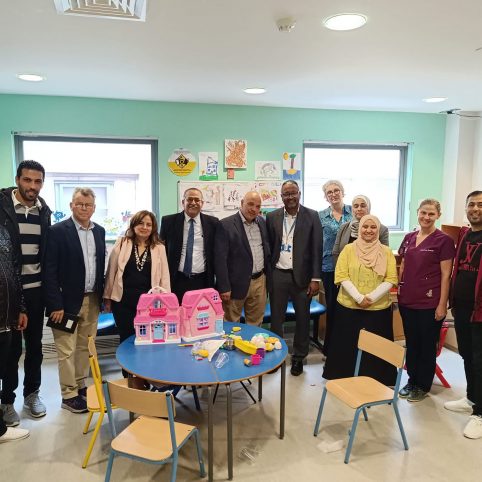
As part of the World Federation of Hemophilia (WFH) Twinning Programme, the Irish Haemophilia Society (IHS) and the Jordanian Thalassemia and Haemophilia Society (JTHS) twinned as National Member Organisations from 2018 to 2024. Whilst we did have some difficulties with schedules and training, due to the COVID-19 pandemic, the twinning programme was still a success.
Following a site visit by representations from WFH and from our Chief Executive, in September 2019 our Chairperson met with the organisation in Amman to develop future priorities.
Strengthening Governance
The meeting began with a governance workshop using WFH training materials. The discussion helped the JTHS team review their current structures and identify areas for improvement. A governance questionnaire confirmed that legal requirements in Jordan guide many of their procedures. The team agreed that a more active, structured approach to governance would support their long-term development.
Action Plan
The 2019 action plan was assessed, with progress varying across activities. While one educational meeting for people with haemophilia was delivered successfully, other planned actions—such as training on publications, event planning, and governance review—were not fully achieved due to limited resources. A follow-up visit by IHS staff was scheduled for February 2020 to support these areas.
Setting Priorities
The strategic planning session highlighted major challenges faced by the JTHS, particularly the overwhelming focus on treatment availability in Jordan. To help build a stronger and more sustainable patient organisation, the group agreed on three achievable priorities:
- Create and distribute clear educational publications
- Increase membership from 70 to 140 people with haemophilia
- Review governance structures and policies
Quality of Life Meeting with Families
A separate session took place at Al Bashir Hospital with parents and children living with haemophilia. Many families shared personal stories and concerns, highlighting a limited understanding of haemophilia, genetics, and inhibitors, fear surrounding the condition and a need for better guidance on exercise, physiotherapy, and daily management.
Over the course of the twinning programme, although difficulties arose due to the COVID-19 pandemic and the war in the middle east, various online training programmes and sessions took place, which were a great success with excellent attendance from the board, members of their organisation and various clinicians.
Visit to Ireland
We were very pleased to welcome our colleagues from Jordan to Dublin in July 2024 for a week of training and activities. We had a structured programme of training, observation, and organisational development. The visit aimed to strengthen clinical knowledge, enhance governance capacity, and build collaborative links between the Jordanian team and key Irish healthcare partners. The schedule covered a full week and included meetings across hospitals, departments, and support services relevant to haemophilia care and NMO operations.
The first formal day of the programme focused on clinical education and observation. Activities included:
- Introductory meetings with the hosting team
- Overview of Irish haemophilia services
- Initial clinical discussions and familiarisation with care pathways
- Engagement with hospital departments relevant to the training agenda
This day set the foundation for the delegation’s understanding of Ireland’s multidisciplinary model of care.
Training continued with a deeper focus on clinical practice and patient management with our colleagues at the National Coagulation Centre (NCC) at St. James’s Hospital. The delegation engaged in:
- Sessions on treatment protocols
- Exposure to clinical documentation and workflows
- Discussion on laboratory practices
- Observations within specialised units
Particular emphasis was placed on consistency in treatment supply and the operational roles of clinical teams.
The delegation also participated in structured educational activities, including:
- Workshops relevant to patient services
- Continued engagement with physiotherapy, orthopaedic, and clinical departments
- Review of patient case scenarios
- Strengthening understanding of multidisciplinary team functions
We also did training on NMO governance and organisational development. Activities included:
- Discussions on advocacy and patient support
- Sessions on NMO structure, roles, and responsibilities
- Training on administration, communication, and strategic planning
- Publications and social media
- Outreach
- Policies & procedures
- Events and activities
- Action-planning for the Jordanian NMO
- Identification of priorities for service improvement
- Consideration of multidisciplinary development within Jordan’s healthcare system
- Review of logistical, administrative and financial practices
The July 2024 visit offered the Jordanian NMO a comprehensive opportunity to observe clinical practice, understand Ireland’s multidisciplinary care model, and strengthen their own organisational capabilities. The week-long engagement fostered collaboration, knowledge exchange, and the development of practical plans to advance haemophilia care and patient support in Jordan.
Following the visit from our colleagues a further follow up Zoom meeting was arranged towards the end of July 2024. The discussion focused on clinical practices, treatment availability, laboratory standards, and progress within the Jordanian medical teams following recent training in Ireland.
Achievements & Challenges of the Twinning Programme
A notable achievement is the initiative led by the two female Jordanian doctors, who are advocating for the establishment of a new multidisciplinary team. They have already secured support from the physiotherapy department and orthopaedic surgeons, and momentum on this initiative is steadily growing.
The challenges we observed during the twinning programme include:
-
- The need for a consistent supply of treatment, especially for home therapy
-
- Better treatment options and reduced hospital waiting times
-
- The potential creation of a scientific advisory group, similar to the HPSMAB model
-
- Successful training sessions completed with the NMO team on governance, finance, action planning, membership, events, and publications
It is excellent to see that the board and Dr. Qasem, are actively pursuing and pressing the government on all of these issues. The board are playing a key role in securing government approval for home treatment, and progress to date appears promising.
While treatment availability remains the most urgent issue in Jordan, the development of a stronger patient organisation and the work they do, will significantly strengthen advocacy and improve quality of life for people with haemophilia in the years ahead, and we wish everyone in Jordan the very best. It has been a pleasure working with our colleagues and we hope to assist the organisation in the near future.
Find out about our other twinning programmes here.
Find out more about WFH twinning here.